
At 11:12 a.m., the line outside the shop isn’t dramatic. No cheering. No “we made it” energy. Just people holding phones at chest height, scrolling with the steady patience of commuters waiting for a train they already know will come.
Near the front, a couple isn’t arguing about whether the dessert is good. They’re arguing about time.
“How long do you think this will last?”
It sounds like a joke, but it isn’t. Everyone in line understands the premise: it won’t last. Something else will take its place. That’s what makes it easy to talk about—no one has to defend their taste. They’re just placing a bet on the calendar.
And still—here they are.
Not because they believe the thing is timeless. Because they recognize the brief window when an object becomes a reference.
The question that isn’t a question
“How long will this last?” isn’t really a forecast. It’s closer to a social check-in.
You hear it in office pantries and elevators. At cafe counters. In group chats that move faster than anyone wants to admit. A trend is the safest kind of topic: easy to mention, easy to drop, no personal confession required.
Sometimes the meaning is almost embarrassingly simple:
Are you in the same moment I’m in?
There’s usually a second line hiding behind it, too. The moment rarely arrives alone. It arrives with a frame already built around it.
You don’t just “find” the trend. It shows up pre-approved—on your feed, in your recommendations, in the exact same 12-second clip you’ve already seen twice today.
So the question can also mean:
Did it show up for you too?
A shelf of short-lived objects
The names change, but the rhythm repeats: arrival, concentration, shared reference, replacement.
Up close, it leaves residue—sometimes literal.
1) Honey butter chips (circa 2014): when “got it” becomes the story
Honey butter chips are a Korean potato chip that went briefly feral: sweet-salty, butter-forward, and suddenly “sold out” everywhere.
There was a stretch when a snack wasn’t a snack. It was timing, information, luck—proof you had access.
People didn’t start with flavor. They started with the hunt.
Where did you find it?
Which store still has it?
Did it sell out again?
A bag set on a table worked like a small offering: I thought of you while everyone else was looking for this.
The hunt sounded playful. The underside wasn’t. Scarcity invited tricks—bundles, side purchases, extra items you didn’t want, bought to earn the right to the one you did. The story was cute. The receipt sometimes wasn’t.
2) Pokemon bread (circa 2022): when the product is the wrapper
Pokemon bread is packaged sweet bread sold with a random collectible sticker inside—so people buy it for the sticker, then negotiate what to do with the bread.
Later came bread that plenty of people bought without pretending bread was the point. The real product was the add-on: the random collectible, the brief dopamine hit of opening something sealed and learning what you got.
The conversation wasn’t about taste. It was about results.
Which one did you get?
Do you have duplicates?
Are you missing one?
It turned into a shared game distributed at scale—simple rules, endless repetitions.
And scale has a cost. In the wake of the craze, one detail kept surfacing like the kind of anecdote people repeat because they don’t want it to be normal: bread left behind, eaten halfway, or not eaten at all. The collectible traveled. The food became collateral.
3) Dubai Chewy Cookie (latest wave, 2025–2026): when two cravings compress into one name
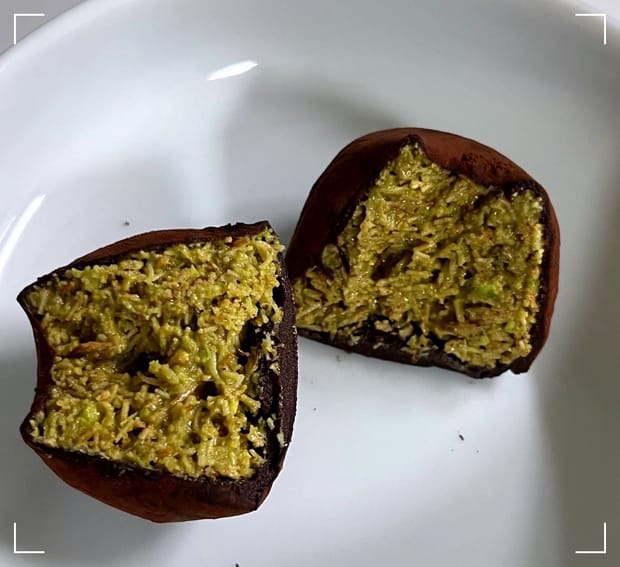
Dubai Chewy Cookie is a mash-up trend: Dubai-chocolate-style richness folded into a dense, chewy cookie format—portable, indulgent, built for instant recognition.
The structure matters as much as the flavor: imported-feeling richness compressed into a handheld format, paired with dense chewiness that signals indulgence. The name behaves like the trend—short, fast, designed for recognition without explanation.
This is also where scarcity turns into a kind of hospitality.
A hard-to-get dessert placed into someone else’s hands says more than “I brought you something.” It says: I spent time, not just money. I stood in the line while it was still the line.
Rarity gets enjoyed twice—once as possession, once as acknowledgment.
What these waves do well
From the outside, fast turnover can look like impatience. From inside the scene, it often looks like low fear around trying something new.
People try first, decide later. They drop a thing without writing a breakup letter when it stops being interesting. They move on without insisting the old thing must remain meaningful forever.
Trends make small talk effortless.
They create instant common ground.
They give strangers a shared timestamp.
Sometimes connection is simply: we saw the same thing at the same time.
The pressure that doesn’t announce itself
Still, something shifts once a trend becomes the default reference.
When something becomes the easiest topic in the room, opting out can look like absence. Not rebellion. Just a blank space where the shared reference should be.
You can see it in small moments: someone says they haven’t tried it yet, and there’s a half-second pause—like the room is flipping through an index card and not finding them.
The mainstream rarely needs to force participation directly. It concentrates attention so tightly that joining becomes the frictionless option.
And because so much attention now arrives through the same pipes—recommendations, rankings, short clips, reposts—the “shared moment” can start to feel less like discovery and more like synchronization.
Not chosen in some dramatic sense. Chosen in the practical sense: this is what the room already knows.
So when someone asks, “How long will this last?” another question sits behind it:
How long can you stay outside it?
Syn-K Takeaway
Eventually, the line disappears. The group chat moves on. The next abbreviation arrives.
“How long do you think this will last?”
Everyone already knows: it won’t.
What remains is the record of attention—where it gathered, what it demanded, what it left behind.
Then something else replaces it.


