
When Words Appear Before Buildings
As evening falls, Korean commercial streets reveal themselves in a particular order.
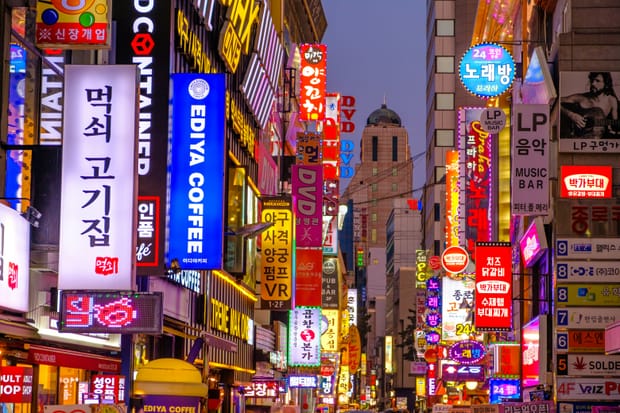
Before the shapes of buildings become clear, words appear first, filling the air above eye level and establishing the street long before its architecture does.
There are more signboards than windows, more business names than floor numbers.
A building here is rarely read as a single structure; instead, it presents itself as a vertical collection of intentions, stacked one above another and competing for recognition.
Fried chicken on the first floor, a karaoke room above it, a gym on the third.
Higher up, a nail salon waits with its lights still off, not closed, but not yet visible.
At night, buildings say more than they do during the day.
For first-time visitors, the experience can feel disorienting. There is no obvious focal point, no clear address to follow. The eyes move upward almost instinctively, pulled toward the accumulation of names already lit and asking for attention.
Signs as Signals, Not Decoration
In this city, signs are not decorative elements added after the fact.
They function as signals, marking presence, availability, and endurance in an environment where conditions are rarely unique.
The street is the same.
The building is the same.
The circumstances, too, are largely shared.
Most businesses operate under nearly identical conditions, opening and closing at similar hours, working within similar margins, and offering differences that are often incremental rather than defining. As a result, distinction is pursued visually. Names grow larger, lights grow brighter, and signboards begin to overlap as each business presses slightly harder to remain noticeable.
Lower floors fill quickly, rewarded by visibility and convenience. Upper floors wait longer, relying on persistence rather than impulse. In this structure, being seen is not enough. What matters is the appearance of staying—of remaining part of the street’s nightly rhythm.
What the Signs Carry
From a distance, these streets appear active.
Lights stay on late, names change often, and movement seems continuous, giving the impression of energy and renewal.
But much of this activity forms in places where institutional support thins. Employment does not always conclude with security, and income often pauses while expenses continue uninterrupted. Benefits, when they exist, tend to be limited in duration and scope, insufficient to fully bridge what comes next.
Between leaving formal work and reaching a retirement that can actually be lived on, there is a long interval with no assigned structure. During this time, stability quietly shifts from system to individual.
Savings convert into mortgage payments still due.
Experience becomes inventory.
Labor replaces guarantees.
The signs absorb this transition. They remain lit not simply to attract customers, but to persist—to signal that the effort to stay visible is still ongoing.
Different Neighborhoods, Same Structure
In Jongno, signs cover the wear and uneven surfaces of aging buildings, layering new intentions over older foundations. In Sinchon, similar businesses press against one another at the same heights, testing minor variations within the same vertical band. In Busan’s commercial districts, signs briefly orient themselves toward the sea before turning back toward the street, acknowledging both openness and competition.
The locations differ, but the structure remains.
The city does not organize itself horizontally. It accumulates vertically, stacking attempts rather than spreading them out.
Reading the City by Its Names
Finding your way here is not a matter of reading addresses.
It is a matter of reading names.
Not which floor a place occupies, but which sign is still lit, which one continues to return night after night. At first, the density can feel overwhelming—too many lights, too many attempts sharing the same space.
Over time, however, a rhythm becomes visible.
This is not disorder, but density shaped by pressure, repetition, and endurance.
Syn-K Takeaway
What these streets reveal is not abundance, but persistence.
Signs grow larger not because they want to, but because standing still is rarely an option.
To read this city is to notice how staying often matters more than standing out, and how visibility itself becomes a form of work.
And tonight, once again, the signs will turn on before the buildings do.


